


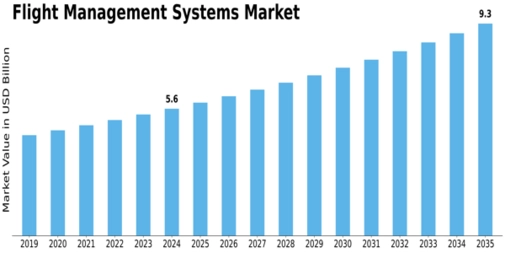
Rising Need for Efficiency and Precision
Aviation stakeholders worldwide are seeking operational precision, fuel efficiency, and enhanced safety—all of which have placed flight management systems (FMS) at the center of cockpit modernization. The push toward global airspace harmonization and optimized routing is creating steady demand across civil and military segments.
Expansion of Operational Scope
The Flight Management Systems Market has benefited from surging air passenger numbers and increased aircraft production. Airlines now demand advanced systems that integrate seamlessly with autopilot, navigation, and engine management modules. The requirement to comply with evolving performance-based navigation standards continues to encourage investment in both new-build and retrofit programs.
Technological and Economic Catalysts
Growing emphasis on automation, reduced pilot workload, and flight trajectory optimization has accelerated product innovation. Upgrades such as intuitive graphical interfaces and satellite-linked databases make flight planning more accurate. Economically, the need to minimize fuel burn and maintenance costs sustains long-term interest in high-efficiency FMS solutions.
Role of Market Intelligence in Identifying Demand
Robust market intelligence enables aviation stakeholders to quantify demand by fleet size, aircraft class, and regulatory requirement. Such intelligence informs manufacturers about procurement priorities, allowing precise alignment with operator needs. Continuous analysis of airline expansion strategies provides insights into replacement cycles and upgrade timing.
Sustained Outlook
With flight volumes expanding and aircraft becoming more connected, demand for adaptive, upgradable, and cybersecure FMS platforms is set to strengthen globally through the next decade.

 English
 Arabic
 French
 Spanish
 Portuguese
 Deutsch
 Turkish
 Dutch
Dutch
 Russian
 Romaian
 Portuguese (Brazil)
 Tiếng Việt